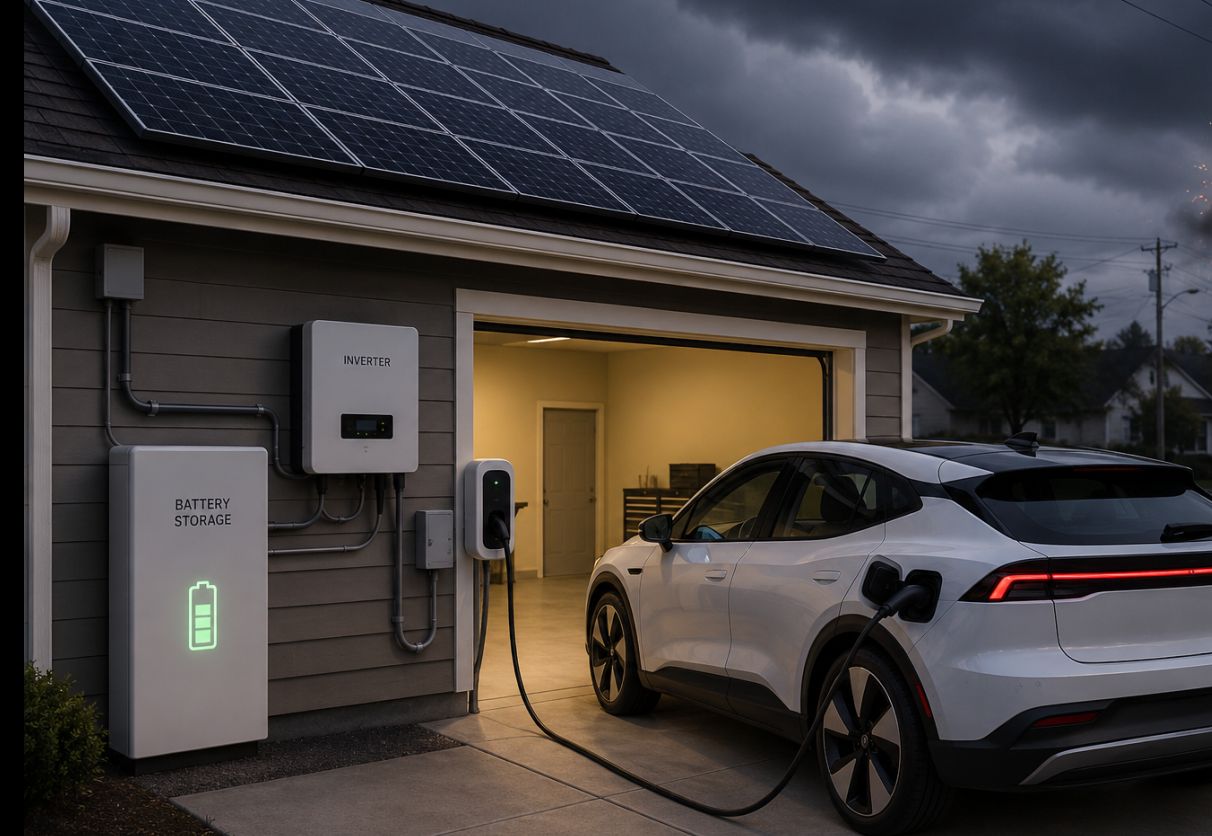
A storm knocks out power, the phone battery is at 19 percent, and the EV in the garage suddenly looks like the biggest battery on the property. It is a fair question: if solar panels are on the roof, can they keep charging the car while the grid is down?
The answer is yes in some cases, but not with ordinary grid-tied solar alone. A backup-capable system needs a way to separate from the grid, manage loads safely, and route solar or stored energy to the charger. Without that equipment, most solar systems shut down during an outage to protect utility workers and equipment.
Why Standard Solar Usually Stops
Most home solar systems are designed to operate with the grid. When the grid fails, the inverter normally shuts off. That safety behavior prevents the solar array from pushing electricity back into lines that crews may be repairing.
To keep operating, the home needs an islanded energy system. In simple terms, the battery and inverter create a protected electrical zone for selected loads. Solar can then power those loads and recharge the battery when sunlight is available. If EV charging is included in that zone, it has to be managed carefully because it can draw more power than many household appliances combined.
The U.S. Department of Energy says bidirectional charging can unlock resilience benefits from EV batteries and provide backup power. That does not mean any charger can do it. The EV, charger, inverter, transfer equipment, and local code requirements all have to line up.
Charging the Car Is Not the Same as Backing Up the House
During an outage, the priority may not be adding range. It may be keeping refrigeration, lights, medical equipment, internet, and a few outlets running. EV charging can be added, but it should not accidentally drain the home battery before morning.
A useful design approach is to create charging rules. The system might allow EV charging only when solar production is above household load, or only after the stationary battery reaches a reserve level. It might also cap charging power so the car does not overwhelm the backup system.
ESYsunhome’s home solution page describes a setup that combines solar, battery storage, EV charging, and backup use cases. For homeowners comparing this kind of architecture, the context at https://www.esysunhome.com/for-home/ is relevant because the EV charger is treated as part of the home’s broader energy ecosystem.
What Has to Be in Place
A home that wants outage charging should check four things before buying equipment:
- Backup-capable inverter and transfer equipment
- Battery reserve settings for essential loads
- EV charger power limits and scheduling controls
- Local permitting, utility, and interconnection rules
The National Renewable Energy Laboratory’s PVWatts tool is often used to estimate solar production by location and season, which matters during extended outages. A sunny spring outage is a different planning problem from a winter storm with short days and heavy heating demand.
Vehicle-to-home can add another layer. If the EV and charger support V2H, the car may help power the home. ESYsunhome lists EV22 V2E as V2H and V2G ready, which points to that bidirectional future. Still, a car is mobile. It may not be home, fully charged, or compatible when the outage starts.
Solar can charge an EV during an outage, but only inside a system designed for that job. The safest plan is not to assume the panels will handle everything. It is to decide which loads matter first, then give EV charging a controlled role after the essentials are covered.